WordPress or a custom website for conversion?
Should you go with the popular WordPress or have a fully custom website built? We compare both options on performance, flexibility, maintenance, and — most importantly — conversion.


When you need a new website for your business, you quickly arrive at the big question: WordPress or a custom-built website? It's a debate that has raged for years in the web design world, and the answer depends on many factors.
But there's one factor that's often forgotten in this debate: conversion. Which approach ultimately delivers more customers, leads, or sales? In this article, we honestly examine both options from that perspective.
WordPress: The World's Most Popular CMS
WordPress powers more than 43% of all websites worldwide. From small blogs to large business websites, it's by far the most widely used content management system.
Advantages of WordPress
1. Quick to go live With WordPress, you can set up a professional website relatively quickly. There are thousands of themes available, and with a page builder like Elementor or Divi, you can create a beautiful website without code.
2. Large ecosystem There are more than 60,000 plugins available for virtually any functionality you need: SEO, forms, e-commerce (WooCommerce), multilingual support, security, and more.
3. Content management WordPress is originally a blogging platform, and content management is therefore excellent. You can easily add, edit, and publish pages without technical knowledge.
4. Lower initial costs A WordPress website is generally cheaper to build than a fully custom website. There are plenty of freelancers and agencies that offer WordPress websites.
5. SEO-friendly With plugins like Yoast SEO or RankMath, you can optimize your website well for search engines. WordPress generates clean URL structures by default and is easily indexable.
Disadvantages of WordPress
1. Performance challenges WordPress websites often become slow due to:
- Too many plugins conflicting with each other
- Heavy page builders that generate excessive code
- Non-optimized themes with unnecessary features
- Poor hosting
A slow website means lower conversion rates and worse Google rankings.
2. Security risks Because WordPress is so popular, it's also a popular target for hackers. Without regular updates of WordPress core, themes, and plugins, you're at risk.
3. Plugin dependency Every additional plugin is a potential risk: updates that break your site, conflicts with other plugins, or plugins that are no longer maintained.
4. Limited customization options Although WordPress is flexible, you'll hit limitations with themes and page builders. If you want something truly unique, you still need to write custom code, and that's not always elegant within WordPress.
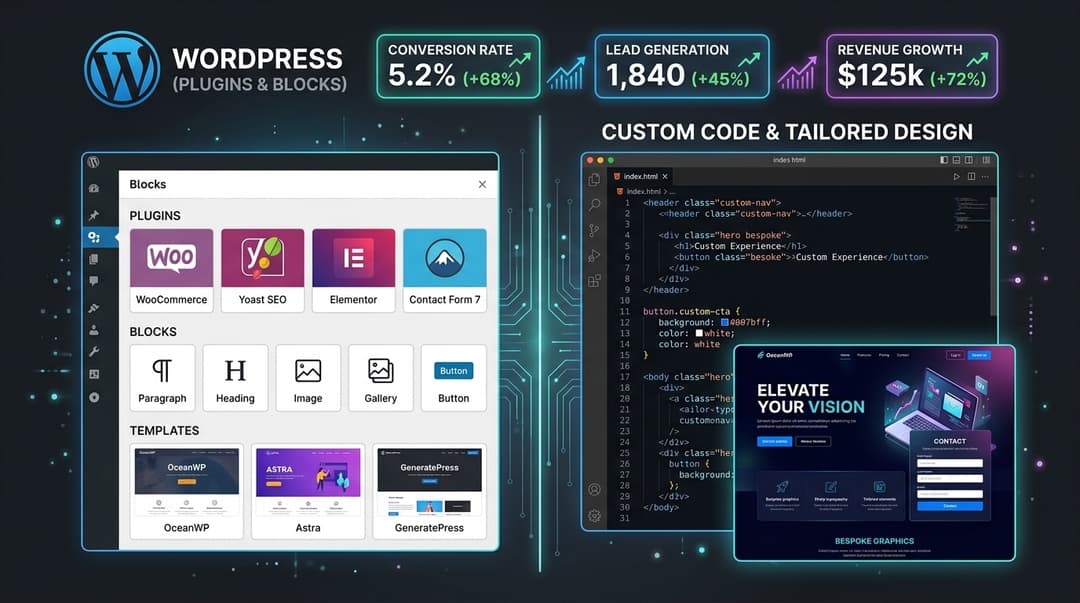
Custom Websites: Fully Tailor-Made
A custom website is built from scratch with modern web technologies. Think of frameworks like React, Next.js, or a headless CMS solution.
Advantages of Custom
1. Maximum performance No unnecessary code, no heavy plugins, no bloated themes. A custom website contains only what's needed, resulting in:
- Lightning-fast load times
- Higher Core Web Vitals scores
- Better Google rankings
- Higher conversion rates
2. Complete design freedom There are no limitations from themes or page builders. Every element can be designed and implemented exactly as you want. This means the design can be fully tailored to conversion optimization.
3. Better security Without WordPress core, themes, and plugins as an attack surface, a custom website is inherently more secure. Less maintenance is needed to patch security vulnerabilities.
4. Scalability Custom websites can be built with scalability in mind. As your business grows, your website grows with it without the limitations of a CMS framework.
5. Unique user experience You can build interactive elements, animations, and user flows that perfectly align with your target audience and conversion goals.
Disadvantages of Custom
1. Higher initial investment A custom website costs more to build. Development time is longer and you need experienced developers.
2. Content management can be more complex Without a user-friendly CMS like WordPress, editing content can be more difficult. This can be solved with a headless CMS, but that adds complexity.
3. Dependency on developers For changes, you need access to a developer. With WordPress, you can do a lot yourself or via plugins.
4. Longer time-to-market Building a custom website takes longer than setting up a WordPress site. If you need to be online quickly, this is a disadvantage.
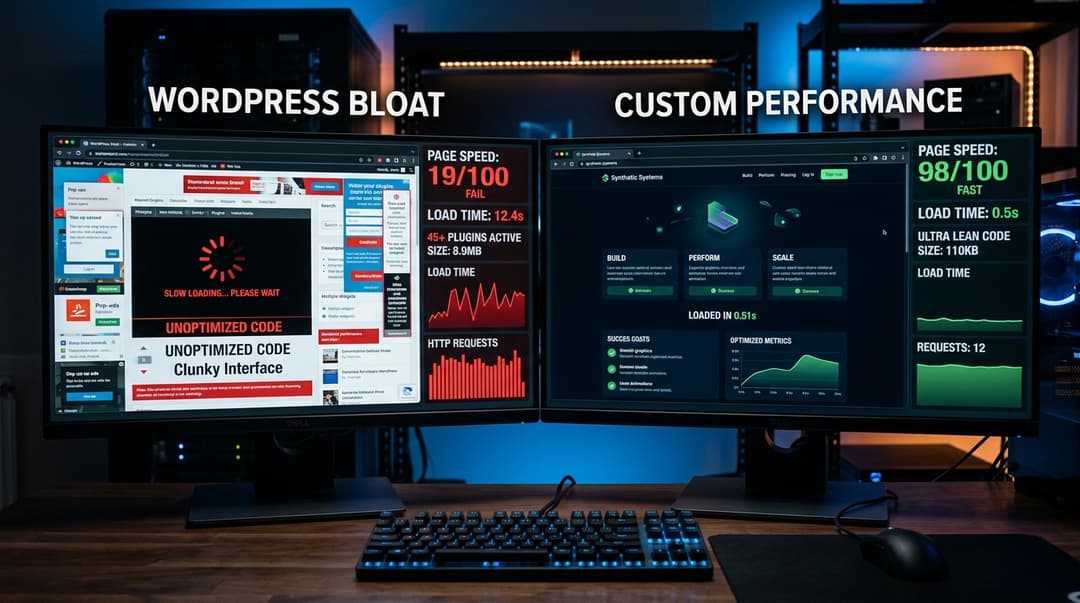
The Conversion Comparison
Let's now look at what really counts: which approach delivers more conversions?
#
Load Time and Conversion
Studies consistently show that speed is important for conversion:
- A delay of 1 second reduces conversions by an average of 7%
- Websites that load in 1-2 seconds have the highest conversion rates
- 53% of mobile visitors leave a site that takes longer than 3 seconds to load
Advantage: Custom. Well-built custom websites are almost always faster than WordPress sites with plugins and page builders.
Design Flexibility and Conversion
Conversion optimization sometimes requires unconventional design solutions:
- Custom conversion funnels
- Personalized user experiences
- Interactive tools and calculators
- Complex forms with conditional logic
Advantage: Custom. Complete freedom makes conversion-optimized design easier to implement.
Content and SEO
Good content is essential for organic traffic, which then converts:
- Regular blogging and content updates
- Managing SEO meta tags and structured data
- Publishing new pages quickly
Advantage: WordPress. The CMS makes content management more accessible, leading to more consistent content output.
A/B Testing
To optimize conversion, you need to test:
- Different headlines and CTAs
- Layout variations
- Form optimizations
Tied. Both platforms support A/B testing via external tools (Google Optimize, VWO, etc.).
The Decision Framework: Which Choice Is Right for You?
Choose WordPress if:
- You have a limited budget for the initial build
- You want to manage content yourself without technical knowledge
- You need a standard website (brochure site, blog, small webshop)
- You want to be online quickly
- You need simple functionality that can be covered by plugins
Choose Custom if:
- Performance is key for your business (every second counts)
- You need a complex web application (calculators, dashboards, portals)
- You want maximum conversion optimization without design limitations
- You can justify a larger investment due to higher expected revenue
- You operate in a competitive market where every edge counts
- You want lower maintenance costs in the long term
The Middle Ground: WordPress with Expert Setup
There's also a middle solution: a WordPress website that is built by experts with a focus on performance and conversion. This means:
- A lightweight theme without a page builder
- Minimal plugin usage
- Optimized hosting
- Custom code where needed for conversion elements
This gives you the advantages of WordPress (content management, speed of setup) with better performance than a standard WordPress site.
Conclusion
The question "WordPress or custom?" is actually the wrong question. The right question is: "Which approach gives me the best return on investment?"
For some businesses, a well-built WordPress website is more than sufficient. For others, a custom solution is worth the investment due to higher conversion rates and better performance.
At Saerens Advertising, we always advise based on your specific situation, goals, and budget. We build websites that are attractive and demonstrably perform. Whether that's on WordPress or custom, results are what matter.
Want to know which approach is best for your business? Request a free consultation and we'll explore together what the smartest investment is for your online growth.

Need help with your marketing?
Request a free audit today and discover where you're missing opportunities.