What is ROAS and why does it matter?
ROAS is the metric that determines whether your Google Ads campaigns are profitable. Learn what ROAS means, how to calculate it, and why clicks and impressions can be misleading.


Your Google Ads dashboard is full of numbers: impressions, clicks, CTR, average CPC, conversions... It's overwhelming. But there's one metric that truly matters: ROAS. In this article, we explain what ROAS is, why it's more important than all other metrics, and how you can improve it.
Quick disclaimer before we start: there is no universal "good ROAS". A 4x return is great for one business and a disaster for another. This article walks you through the formula, the context that makes it meaningful, and the levers that actually move the number. No guru language, just what we use with clients every week.
What Does ROAS Mean?
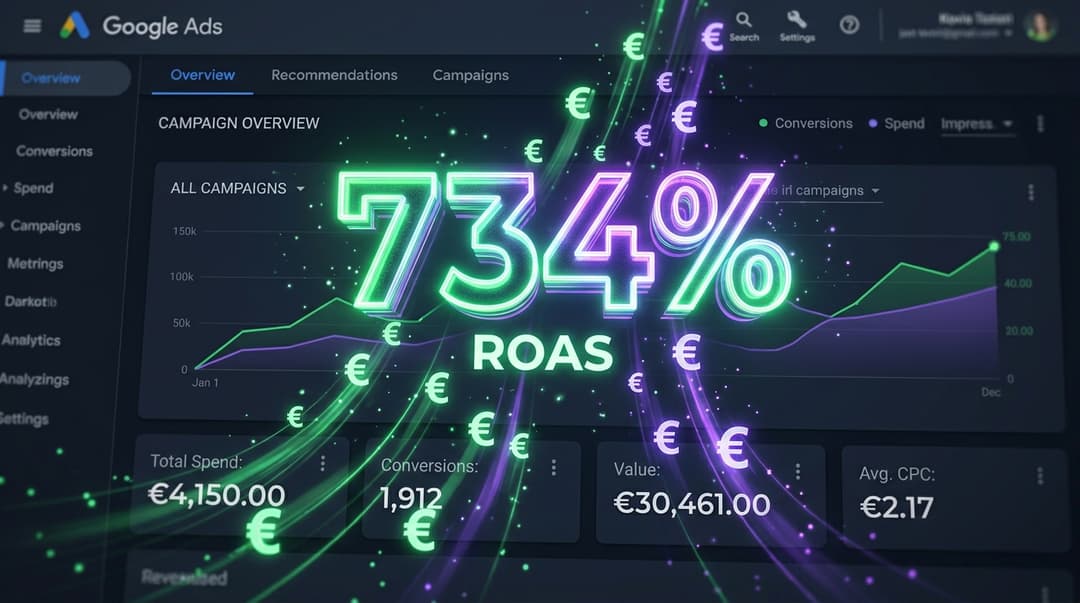
ROAS stands for Return On Ad Spend, which is the return on your advertising expenditure. Simply put: how many euros does every euro you spend on advertising generate?
#
The Formula
The calculation is surprisingly simple:
ROAS = Revenue from ads ÷ Advertising costs
Say you spend €1,000 on Google Ads and this generates €5,000 in revenue. Then your ROAS is:
€5,000 ÷ €1,000 = 5.0 (or 500%)
This means that every euro you invest in advertising returns five euros.
ROAS vs ROI: What's the Difference?
ROAS and ROI are often used interchangeably, but they are not the same:
- ROAS only looks at advertising costs versus revenue. It doesn't account for production costs, operational costs, or margins.
- ROI looks at all costs (including product costs, shipping, staff costs) versus net profit.
ROAS is a marketing metric that tells you how effectively your advertising budget is being spent. ROI is a business metric that tells you whether you're making a profit at the bottom line.
Both are important, but for optimising your Google Ads campaigns, ROAS is the metric you want to track.
Why Clicks and Impressions Are Misleading
Now you understand ROAS. But why are clicks and impressions so misleading?
The Problem with Impressions
Impressions tell you how many people have seen your ad. Sounds good, right? But:
- An impression doesn't mean someone consciously noticed your ad
- More impressions cost more money but don't necessarily deliver more customers
- It's a vanity metric that looks good on paper but says nothing about results
The Problem with Clicks
Clicks are a step better, since someone consciously clicked on your ad. But:
- Not all clicks are equal. A click from someone who googled your product is more valuable than an accidental click.
- Clicks without conversion cost money, and every click that doesn't convert is wasted budget.
- More clicks don't mean more revenue. You can get thousands of clicks and still run at a loss.
- Click fraud is real. A portion of your clicks may come from bots or competitors.
A Practical Example
Imagine: two campaigns with the same budget of €1,000.
Campaign A:
- 2,000 clicks
- CTR of 5%
- 10 conversions
- €2,000 revenue
- ROAS: 2.0
Campaign B:
- 500 clicks
- CTR of 2%
- 25 conversions
- €8,000 revenue
- ROAS: 8.0
If you only look at clicks and CTR, Campaign A appears better. But Campaign B delivers four times the return. This is precisely why ROAS is the metric that counts.

What is a Good ROAS?
This is the question everyone wants answered, but the answer is nuanced. A good ROAS depends on:
1. Your Profit Margin
This is the most important factor. If your margin is 80% (as with software or digital products), then a ROAS of 2.0 is already profitable. But if your margin is 20% (as with many physical products), you need a ROAS of at least 5.0 to break even.
2. Your Industry
Average ROAS differs by sector:
- E-commerce typically expects a higher ROAS due to direct sales
- Lead generation makes the ROAS calculation more complex because of longer sales cycles
- B2B can accept a lower ROAS when customer value is high
- Local services depend heavily on the average order value
3. Your Campaign Goal
Not every campaign is aimed at direct sales:
- Brand awareness campaigns naturally have a low ROAS, since the goal is visibility
- Remarketing campaigns should show a higher ROAS because you're targeting warm audiences
- New customer acquisition can accept a lower ROAS if the customer lifetime value is high
4. Customer Lifetime Value (CLV)
If a customer stays with you for an average of three years and spends a certain amount annually, then the initial acquisition can cost more. Look at the total customer value, not just the first transaction.
How Do You Improve Your ROAS?
Now for the most important part: how do you get more return from your advertising budget?
1. Improve Your Conversion Tracking
You can't improve ROAS if you're not measuring it properly. Ensure you have:
- Correct conversion tracking via Google Tag Manager
- Enhanced Conversions for more accurate measurement
- Offline conversion import if you close sales offline
- Conversion values assigned to each conversion
2. Optimise Your Keywords
Focus on keywords that convert, not keywords that generate clicks:
- Analyse your search terms report to find which search terms lead to conversions
- Add negative keywords to block irrelevant search queries
- Focus on commercial intent, since terms like "buy", "order", and "quote" are more useful than "what is" or "how does"
- Test long-tail keywords, because more specific terms have higher conversion rates
3. Improve Your Ads
Better ads attract the right people:
- Write specific headlines that mention your product, price, or USP
- Use a strong CTA that tells people what to do
- Match the search intent so your ad aligns with what someone is searching for
- Test multiple variants and continuously A/B test your ad copy
4. Optimise Your Landing Pages
The click is just the beginning. Your landing page needs to convert:
- Relevance: the page must match the ad
- Speed: every second of load time costs conversions
- Clear CTA: make it easy to take action
- Social proof: reviews, testimonials, trust badges
- Mobile-first: more than 60% of traffic comes via mobile
5. Use Smart Bidding Strategies
Google's AI can help you improve your ROAS:
- Target ROAS bidding lets you set a target and let Google optimise
- Maximize Conversion Value optimises for revenue instead of volume
- Portfolio bid strategies combine multiple campaigns for better optimisation
Note: these strategies only work well with sufficient conversion data. Google needs a minimum of 15-30 conversions per month to optimise effectively.
6. Segment Your Campaigns
Not all products and services have the same margin or conversion rate:
- Create separate campaigns for high- and low-margin products
- Set different ROAS targets per campaign
- Allocate budget to the best-performing campaigns
7. use Remarketing
Remarketing campaigns typically have a higher ROAS because you're targeting people who already know your brand:
- Website visitors who haven't converted
- Cart abandoners (for e-commerce)
- Existing customers for cross-sell and upsell
Start by Measuring, Then Improving
The first step toward a better ROAS is accurate measurement. Without reliable data, you're optimising in the dark. First ensure your conversion tracking is in order, then focus on the optimisations that have the greatest impact.
At Saerens Advertising, we start every engagement with a thorough analysis of your current ROAS and identify the biggest improvement opportunities. As a Google Partner, we have the expertise and tools to transform your campaigns from clicks to revenue.
Want to know how your ROAS is performing and where the improvement opportunities lie? Request a free Google Ads audit, we'll analyse your campaigns and provide concrete action points.
Related Articles



Need help with your marketing?
Request a free audit today and discover where you're missing opportunities.